Carnivorous Plants
Carnivorous plants have long fascinated man since he first realized what these plants were actually doing. Here are a group of plants that have turned the tables on some of the higher life forms. Instead of the insects preying on the plants the plants have evolved to prey upon the insects. Nearly all have evolved to survive in nutrient poor soil deriving their nutrition from the prey they capture. Their method of attracting and capturing prey is as varied as the plant species themselves.
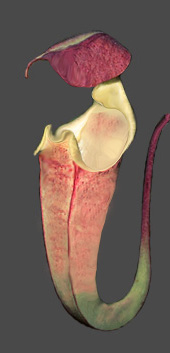
The pitcher plants are typical pit fall traps. The traps are a modified leaf structure in the form of a vase or pitcher which holds water and digestive juices. The rim is a slippery surface where some of these plants secrete a sweet smelling aroma to attract their victims. When the insects come to investigate they slip and fall into their watery grave where they are digested. The Sarracenia have evolved sharp downward pointing hairs within their pitchers which effectively prevents their victims from climbing out. Even many spiders, which are excellent climbers, are not spared. The Nepenthes prevent their victim's escape with slippery walls within the pitcher. Some of the Nepenthes form pitchers large enough to capture small mice although these are not their preferred prey.
The most fascinating of the carnivorous plants is without a doubt the Venus Fly Trap (Dionaea muscipula). In these plants the leaf end has evolved into a bear trap like structure which snaps closed over its prey which it then slowly digests.
Browse through the images and offerings below and see if you don't find them fascinating subjects for your terrarium collection. Keep in mind however that insects are not necessarily their only prey! Click on an image to see a close up.
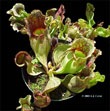
Dionaea muscipula 'Akai Ryu'™ (Venus Fly Trap)
Also known as the Red Dragon Fly Trap. This is a mutation of the common
fly trap. First cloned by the Atlanta Botanical Gardens this one develops
deep red coloration over the entire plant when grown in bright light.
The hairs on the trap are normal as in the common wild type. Care and
growth is the same as other fly traps but the best coloration will develop
in bright light. In low light conditions it will tend toward green with
bright red highlights as seen in the photos.
As with all our carnivorous plants these are grown from tissue cultures and never collected from the wild. Read more about this fascinating species in The Carnivorous Plant FAQ (link opens in a new window)
Sold as a mature plant in a 4 inch pot.
Item # CP-VFTRD1 Status: In Stock Price: $5.00 ea.
Drosera spathulata 'Fraser Island Form'
A tropical Sundew. Develops a nice red coloration in bright light. Stays
short, less than 2 inches tall and will eventually form a nice cluster
of plants. Flowers constantly. Flower stalks will be up to 3 inches
tall. These can take nearly full sun conditions but should be acclimated
gradually from low light.
As with all our carnivorous plants these are grown from tissue cultures
and never collected from the wild. Read more about this fascinating species in
The Carnivorous Plant FAQ (link opens in a new window)
Sold as mature, flowering plants in a 4 inch pot.
Item # CP-FISD1 Status: In Stock Price: $5.00 ea.
Nepenthes alata
This species is found only in the Philippines and has many variant forms.
It can also be found in both highland (cool growing) and lowland (warm
growing) environments.
The variant we sell is a lowland type. It is a very forgiving Nepenthes and makes a great beginner plant. The pitchers will grow up to 6 inches long when mature.
As with all our carnivorous plants these are grown from tissue cultures or cuttings and never collected from the wild. Read more about this fascinating species in The Carnivorous Plant FAQ (link opens in a new window)
Sold in a 4 inch pot containing two well started plants with several pitchers.
Item # CP-NEPAL1 Status: Out of Stock Till Spring '09 Price:
